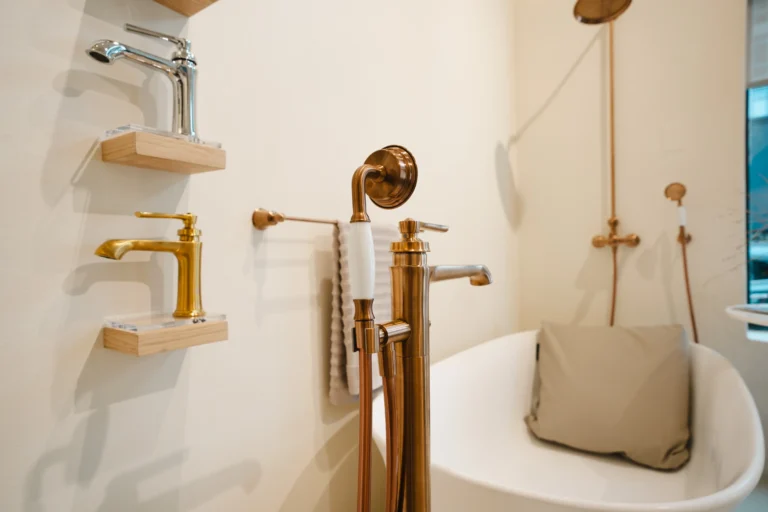
Bathroom finishes built from a single material read as flat. Depth comes from contrast: the warmth of brass against the cool precision of stainless steel, both set against the quiet mass of solid surface. Strong bathroom finishes are less about how many materials a bathroom holds and more about the relationship between them.
Brass: Warmth and Craft
Brass carries warmth that no other bathroom material replicates convincingly. Its tone shifts with finish, from a bright polished gold to a warmer, softer copper tone, which gives brass a wider design range than its reputation for classic interiors suggests. Brass also develops character over time, a quality covered in more detail in our guide to maintaining luxury bathroom fittings.

Vitruvius Basin Mixer in Brushed Copper.

Vitruvius Stand Mount Basin Mixer in Brushed Copper.
Stainless Steel: Precision and Contemporary Ease
Stainless steel brings a cooler, more restrained presence. It holds a sharp edge, resists corrosion without demanding much upkeep and suits bathrooms where the fittings are meant to support the design rather than lead it. Our earlier comparison of stainless steel and brass bathroom fittings sets out the practical differences between the two in more depth.
Solid Surface: Continuity and Form
Where brass and stainless steel add detail, solid surface provides mass. A basin or bath in solid surface reads as a single continuous form, which grounds a bathroom and gives the metal fittings around it somewhere to sit visually. Our guide to solid surface baths and basins explains why the material holds its form and colour over time, which matters when it is doing the visual heavy lifting in a mixed-material room.
Principles for Mixing Materials Successfully
Choose one dominant metal. A bathroom with brass and stainless steel in equal measure competes with itself. Let one metal lead across the taps, mixer and shower fittings, and use the second in a smaller role, such as a towel rail or accessory set.
Match undertone before finish. Warm brass sits more easily against a warm-toned solid surface than against a cool grey one. Checking undertone first prevents finishes that are individually correct from clashing once installed together.
Let the solid surface stay neutral. Because a solid surface basin or bath already carries visual weight, a busier or higher-contrast finish leaves less room for the metal fittings to register. A calmer tone gives brass or stainless steel the space to stand out.
Where to Mix and Where to Match
Mixing works best where surfaces are separated by scale or distance, such as a brass mixer against a stainless steel towel rail across the room. Matching works best at close range, where two fittings sit side by side, such as a basin mixer and its accompanying bath filler. Getting this distinction right avoids the two most common mixed-material mistakes: a room that feels randomly assembled, or one so matched it loses the depth mixing was meant to add.
Frequently Asked Questions
How many materials should one bathroom combine?
- Three is a practical ceiling for most bathrooms: one dominant metal, one solid surface element and at most one secondary metal used sparingly. Beyond that, the room starts to compete with itself rather than reading as considered.
Can brass and stainless steel be used in the same bathroom?
- Yes, provided one leads and the other plays a smaller role. A brass mixer and shower fittings paired with a stainless steel towel rail or accessory set works well. Splitting the two evenly across the same fixture type, such as a brass tap next to a stainless steel tap, tends to look unresolved.
Does solid surface work with both brass and stainless steel?
- It does, since solid surface is available in a wide range of tones and can be matched to either a warm or cool metal palette. The undertone of the solid surface matters more than the finish: a warm-toned solid surface suits brass, while a cooler, greyer tone suits stainless steel.
What is the most common mistake when mixing bathroom materials?
- Treating every material as equally dominant. A room with brass, stainless steel and a heavily patterned solid surface all competing for attention loses the depth that mixing materials is meant to create. Choosing one lead material and letting the others support it produces a more considered result.
Bringing It Together in Your Bathroom
Mixing brass, stainless steel and solid surface rewards a considered hand rather than an even split. Pick the metal that will carry the room, let the solid surface provide the calm plane it sits against and use the second material sparingly enough that it reads as a decision rather than an afterthought.
Explore Vitruvius Design’s range of fittings and solid surface basins to build a bathroom with this kind of depth, or follow @vitruvius_sa on Instagram for further design inspiration.