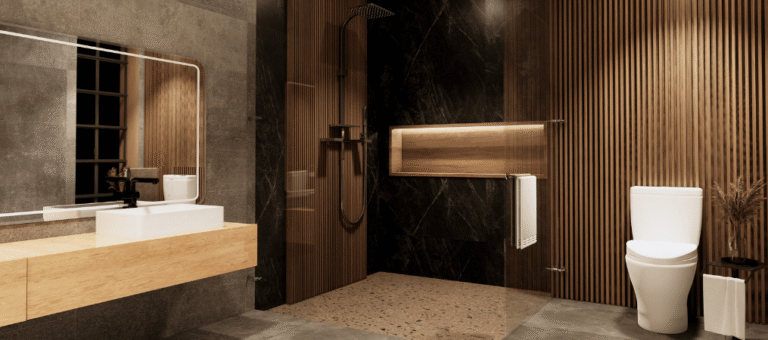
The shower mixer is the control centre of the shower. It governs temperature, flow and the relationship between hot and cold supply. And yet it is one of the most frequently underspecified fittings in a bathroom renovation. Choosing the right type for your plumbing, your wall construction and your design intent makes the difference between a shower that performs for twenty years and one that demands attention within five.
What a shower mixer actually does
A shower mixer combines hot and cold water supplies into a single controlled flow before it reaches the shower head. Unlike a single-supply shower valve, a mixer operates from your home’s separate hot and cold lines, which allows precise temperature and volume adjustment. The quality of that adjustment depends almost entirely on the cartridge inside the body.
Premium mixers, including those in Steinberg’s German-engineered range, use ceramic disc cartridges. Ceramic discs resist scale build-up and maintain consistent performance across thousands of operating cycles. Brass bodies resist corrosion and maintain dimensional stability over time. These are not decorative choices. They are the engineering foundations that determine longevity.
The three types of shower mixer
Before specifying a shower mixer, the installation context determines which type is viable. Each has a different relationship with the wall.
Exposed surface mounted
Body sits proud of the wall surface. Pipework is visible or pipe-boxed. Suited to retrofits and renovation projects where opening walls is not practical or budgeted for.
Concealed in-wall
Valve body is built into the wall cavity. Only the trim plate and handle are visible. Requires proper access provision during the build or wet works phase.
Thermostatic
A separate temperature and volume control. Once temperature is set, the mixer maintains it regardless of fluctuations in supply pressure or temperature.
On thermostatic mixers: In South African homes with variable geyser pressure or shared hot-water systems across multiple bathrooms, a thermostatic mixer eliminates the scalding or cold-shock that occurs when another tap opens elsewhere in the house. For a family bathroom or any shower used by children, the temperature-limiting mechanism is a genuine functional advantage, not a premium add-on.
How to choose: four questions before specifying
1. Is this a renovation or a new build?
Concealed mixers require access to the wall cavity during construction. If tiling is already complete or walls are not being opened, an exposed surface-mounted mixer is the correct choice. Attempting to install a concealed body after tiling almost always results in a compromise in either finish or waterproofing.
2. What are the water pressure conditions?
Both exposed and concealed mixers perform within a pressure range, typically between 0.5 and 10 bar. If your hot and cold supplies operate at significantly different pressures (common where a gravity-fed geyser is on the same floor as the bathroom), the mixer needs either an equalising valve upstream or a pressure-balancing cartridge. Steinberg’s Series 100 concealed valves are designed to accommodate this, but a plumber should confirm supply conditions before specification.
3. What finish will you specify across the bathroom?
The shower mixer is one of the most visible fittings in the space. It should coordinate with the basin mixer and bath mixer finish across the same project. Steinberg offers its full shower range in a consistent finish palette, which makes cross-fitting specification straightforward. Available finishes include Chrome, Matt Black, Brushed Gunmetal, Brushed Gold, Brushed Copper and Brushed Nickel.
4. Does the design call for a single or multi-function outlet?
A basic shower mixer controls one outlet: the overhead or handheld shower. A diverter mixer with two or three way diverter valve allows the same controls to feed multiple outlets, such as a ceiling rain head alongside a handshower on a slide rail. This is where the planning sequence matters. The number of water outlets must be decided before the wall is closed, because each outlet requires its own supply connection at the concealed body.
Choosing by bathroom type
Renovation, single shower: an exposed single lever mixer. No wall access is needed and it installs directly onto existing pipework centres.
New build, primary bathroom: a concealed thermostatic mixer. The clean wall finish and stable temperature control across the household water system justify the additional specification effort at the build stage.
Family bathroom: a thermostatic mixer with a temperature limiter set to 38°C. Anti-scald protection is not optional where children use the shower without supervision.
Walk-in wet room with rain head and handshower: a concealed thermostatic mixer with a 2-way or 3-way diverter. Separate volume and divert controls for each outlet keep the wall plate clean and the operation intuitive.
Guest bathroom or compact ensuite: an exposed single lever or surface-mounted mixer. Cost-effective, maintenance-accessible and finish-coordinated with the basin mixer from the same series.
Steinberg shower mixers at Vitruvius Design
Steinberg’s shower mixer range is engineered in Germany to a level of finish precision that holds across decades of use. Each series follows a consistent dimensional and aesthetic language, meaning the shower mixer, basin mixer and bath spout from the same series share the same proportions and handle geometry. That coherence is difficult to achieve by mixing brands.
Three Steinberg series are particularly well suited to residential specification in South Africa.
Series 350, Finish Set for Single Lever Bath/Shower Mixer with Diverter
A wall-mounted exposed finish set with diverter. Suited to renovations and retrofit projects where a complete single-lever solution with divert functionality is the priority.

Series 350, Finish Set for Concealed Thermostatic Mixer with 2-Way Diverter
A flush-mounted concealed thermostatic finish set with 2-way diverter. The considered choice for new builds and bathrooms requiring consistent temperature control.

Series 340, Shower Mixer Including Concealed Part, Surface Mounting
An exposed surface-mounted mixer supplied with the concealed part included. A complete, installation-ready solution for single-outlet showers.

What your installer needs to know
A well-specified shower mixer only performs as well as its installation. Before your plumber quotes and before walls close, confirm the following:
- Supply connection centres. Steinberg concealed bodies follow standard 150 mm centre spacing, but verify this against your specific model’s technical sheet before setting out pipework. Deviations require additional adapters and visible pipe offsets.
- Minimum operating pressure. Most Steinberg mixers require a minimum of 0.5 bar dynamic pressure. Gravity-fed systems in older homes may fall short without a pump-assist solution.
- Access provision. Concealed thermostatic bodies require a service access point, typically a removable tile panel or a built-in access hatch behind the shower wall. Plan for this during the design phase. Retrofitting access after a tiled wet room is complete is a significant and avoidable cost.
- Pipe sizing. The concealed body’s inlet connection size (1/2″ or 3/4″) should match the existing or planned supply pipework. Reducers introduce pressure loss. Correct sizing from the start preserves flow rate.
Frequently Asked Questions on Shower Mixers
Can I convert an existing exposed mixer to concealed?
- Only during a wet works phase when tiles are removed and wall cavities are accessible. The existing supply connections need to be repositioned to the concealed body’s inlet centres, and adequate depth within the wall cavity is required. It is not a cosmetic swap.
What is the difference between a pressure-balancing and a thermostatic cartridge?
- A pressure-balancing cartridge maintains the ratio of hot to cold water when one supply pressure changes, which prevents temperature spikes. A thermostatic cartridge goes further: it monitors and maintains an exact output temperature regardless of inlet temperature variations. Thermostatic control offers a more precise and consistent shower experience.
Do Steinberg concealed bodies work with any finish set?
- Steinberg rough-in bodies are designed to work with finish sets from the same series. Cross-series compatibility is not guaranteed. Always specify the finish set SKU alongside the body SKU and confirm compatibility before ordering.
Which series is most suited to a minimalist or contemporary bathroom?
- Series 100 and Series 160 are Steinberg’s most restrained lines, favouring clean geometry and tight proportions. Series 350 and Series 390 introduce rounder forms and are well-suited to organic or softly contemporary interiors. Series 310 offers a digital temperature indicator, which suits highly specified smart-home environments.
A shower mixer is a long-term specification decision. The type, the installation method and the finish all carry consequences that outlast the renovation itself. Getting the brief right before walls close, before tiles go up and before pipework is set out, is where most of the value is created.
Steinberg’s engineering philosophy aligns with that thinking. The separation of rough-in body and finish set, the consistent cross-series finish palette and the ceramic cartridge construction reflect a product designed to be specified with intention and to perform without compromise.
Browse the full Steinberg range at vitruviusdesign.co.za/brand/steinberg or visit the Vitruvius Design showroom to experience the fittings in person before committing to a specification.